Flower Essences
Q+A with Phelicia Okon Magnusson
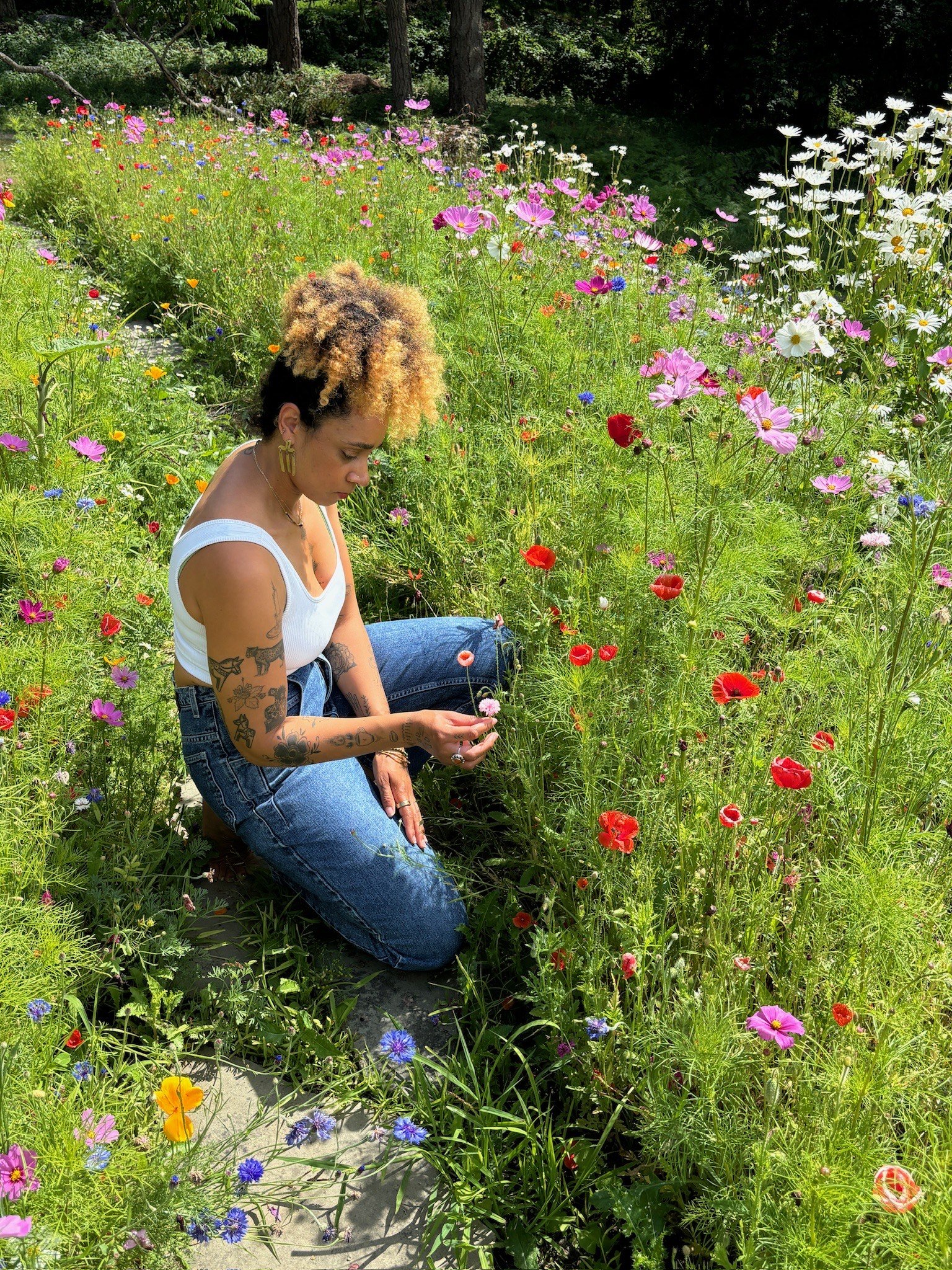
I met Phelicia at this year’s Spirit Weavers gathering, where I was lucky enough to have her as a tent neighbor. Naturally, it didn’t take long for us to discover our shared love of flowers. We found ourselves talking about botanicals, the winding paths that led us to work with them, and the ways flowers can support us in listening more closely to ourselves. Phelicia carries so much beauty and insight, and I’m grateful to share a small glimmer of it here on the Almanac. I hope you enjoy.
Tell us a bit about yourself. How did you find your way into flower essences, somatic herbalism, and intuitive channeling? How did Queen & Crow come to be?
Hi! I am so honored to have been tent neighbors with you at Spirit Weavers and to share a journey with plants that has led us both into deeper relationships with our menstrual cycles, our bodies, and our intuition.
I grew up between very different landscapes. I spent summers in my great grandmother's Brooklyn apartment, watching her tend the pepper plants she grew and added to her stewed chicken, plants that connected her back to her homeland in Sierra Leone. I also watched my mother move through seasons of pruning and planting the forest she tended on the land my family calls home in northern Idaho. My grandmother, too, found peace kneeling in her garden beds, pulling weeds with a patience I rarely saw anywhere else. Long before I had language for it, I understood that the relationships these women had with plants nourished them, and in turn, nourished me.
When I was 22, I began a nine month self study with a yoga teacher who incorporated herbs into our work together. Each month we developed a relationship with a different plant and journaled about how it affected our bodies, emotions, and daily lives. I still remember working with dandelion. Beyond supporting my skin and digestion, it stirred grief and anger that I did not realize I was carrying. That experience changed the way I understood plants and led me to begin studying clinical herbalism at ArborVitae School of Traditional Herbalism.
Although I loved studying clinical herbalism, I eventually left because I found myself longing for other voices in herbalism. I was deeply grateful to understand plant constituents, chemistry, and how herbs work physiologically, but
“I wanted to understand how plants could shift our emotional and spiritual lives and connect us more deeply with our ancestors. That conversation was largely missing from my training, and I knew I needed to keep learning.”
That path led me to study with Dony Cotrina of El Centro de Guadalupe Chaska Suya in Iquitos, Peru. Much of our work centered around floral baths prepared with flowers, water, song, smoke, and prayer. Working with plants in this way brought long held memories and trauma that had been living in my body to the surface. As those memories emerged, I realized I needed a way to meet what was arising with care and support.
When I returned to the States, I began studying generative somatics with Stacey Torres of Everyday Medicine. Somatics gave me a way to listen to my body, not as something to fix, but as something deeply wise. It became the bridge between my healing and my herbal practice.
Along the way, I continued apprenticing with teachers whose work centered relationship, spirit, and reciprocity with the living world. Working in herbal apothecaries in Brooklyn and Seattle while building my private practice, and studying with mentors including Shane Case, Empress Karen Rose, David Dalton of Delta Gardens, and others, have all expanded the way I understand flower essences, ancestral relationship, and what it means to embody our connection to place.
I have also been deeply intuitive for as long as I can remember. As a child, my sensitivity often frightened me, but my mother always reminded me that it was a gift.
“Over the years I have learned that the work is not about becoming more intuitive. It is about learning to tend my sensitivity with discernment, grounding, and integrity.”
Flower essences have been one of my greatest teachers in that process. They help me stay connected to my body, my ancestors, and my intuition without becoming overwhelmed by them.
Over time, my work began to focus more on the emotions and energetics I was seeing alongside people's physical symptoms. Today I weave flower essences, somatic practice, and intuitive guidance together to support people in deepening their relationships with the land, their bodies, their ancestors, and the purpose their lives are asking them to embody.
Queen & Crow Healing Arts grew out of that integration. At its heart is an invitation rooted in reciprocity.
“I believe plants are incredible companions in mirroring back to us our relationship with ourselves, our ancestors, each other, and the natural world.”
My hope is that people leave my work feeling more resourced, more connected to their inner knowing, and more able to walk through their lives with greater presence, trust, and joy.
What is the heart or mission of Queen & Crow Healing Arts?
The heart of Queen & Crow Healing Arts is supporting people in developing relationships of reciprocity with themselves, the land, and their ancestors.
“Relationships that help them attune to the wisdom of their bodies, the mission of their hearts, and what brings them greater joy, pleasure, and peace, so they can embody the fullest expression of who they are.”
Plants are some of my greatest teachers in that process. Whether I’m working with flower essences, somatic practices, or intuitive guidance, my intention is always the same: to create space for people to listen more deeply to their bodies and remember the wisdom that has always lived within them.
I believe our bodies, our ancestors, the natural world, and our lived experiences are always in conversation with us. My work is about supporting people in remembering how to listen.
For someone who is new to them, what exactly are flower essences, and how are they different from essential oils or herbal tinctures?
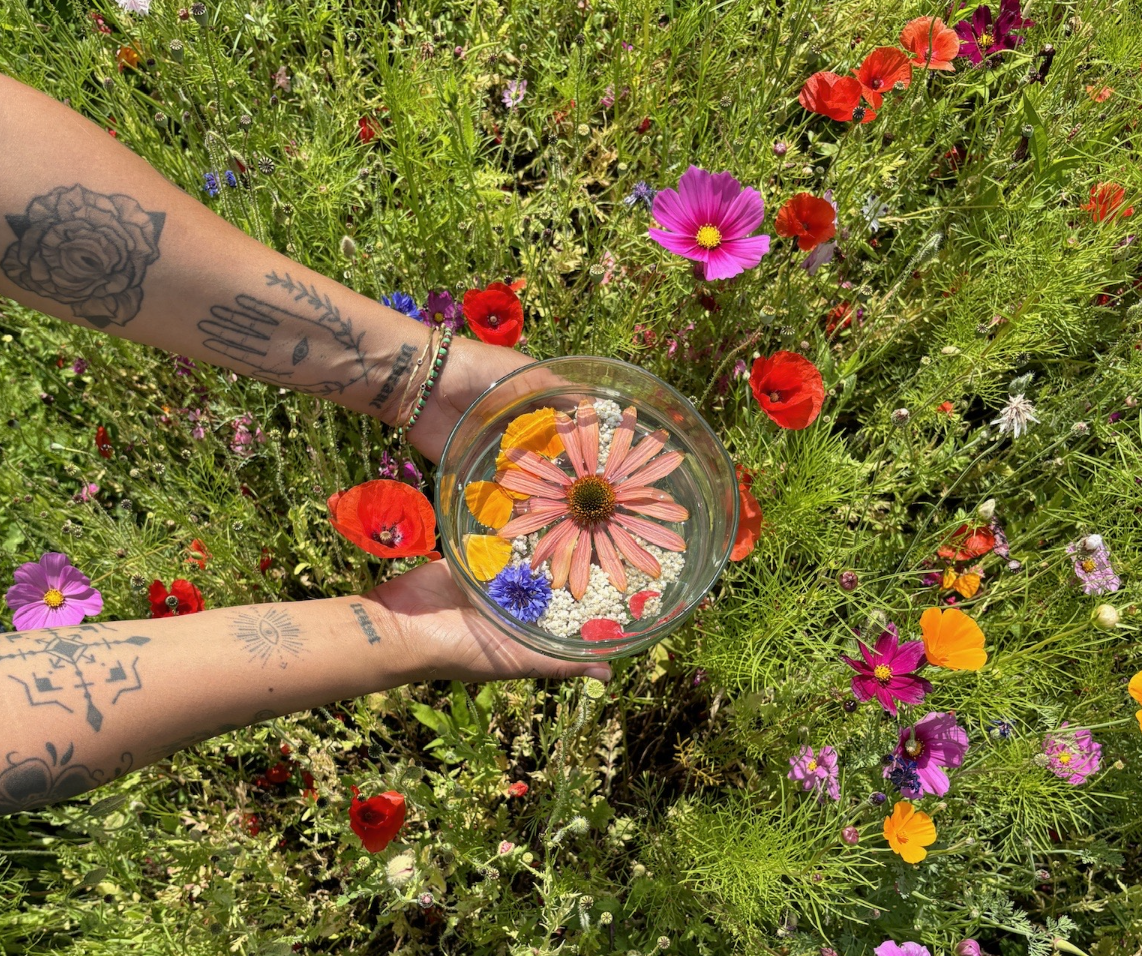
Flower essences are energetic preparations that capture the vibrational signature of a plant in water. Unlike tinctures or essential oils, they do not contain the physical matter or active constituents of the plant. If you were to send a flower essence to a lab, it would test as the menstruum it was preserved in, which in my practice is typically water and brandy or rum.
Because flower essences don’t contain the plant’s active constituents, they work differently than tinctures or essential oils. Rather than engaging the body through the plant’s chemistry, they work in more subtle ways, supporting our emotional, energetic, and spiritual lives. I think of flower essences as companions that invite us into greater awareness of our patterns, our emotions, and our beliefs in gentle ways that meet us where we are.
Because they are not working through the plant’s active compounds, flower essences also don’t carry many of the contraindications that tinctures or essential oils may have for pregnancy, medications, or other physiological considerations. They can be used internally, applied topically, or incorporated into sprays and other everyday rituals.
Although I primarily work with plant essences, essences can be made from many things. Gems, places, astrological event, and meaningful gatherings can all have their energetic signatures preserved in water. The possibilities are expansive, but the intention remains the same: to create a companion that supports us in deepening our relationship with ourselves and the world around us.
How do flower essences work on an emotional, energetic, or somatic level?
In my experience, flower essences often speak to us in the language our intuition already understands. For some people that may be through dreams or images. For others it might be through a felt sense in the body, a shift in emotion, a meaningful conversation, or an unexpected synchronicity. I don’t think flower essences create these experiences as much as they help us become more aware of what is already asking for our attention.
They often highlight our habitual patterns and the places where we are inclined to react rather than respond. They can illuminate beliefs, emotional wounds, or protective strategies that have been shaped by our lived experiences, while gently inviting us to consider new possibilities.
One of the things I love most about flower essences is that they don’t force change. They create the conditions for deeper listening. Over time, I often see people become more attuned to their bodies, more aware of meaningful synchronicities, and more connected to the quiet wisdom that has been present all along.
How can someone begin working with flower essences in a simple, everyday way?
A really beautiful practice for folks who are new to flower essences is to begin with a plant they are already in relationship with. It might be a plant that consistently calls for their attention whenever they see it in the world. Or they might look within their lineage or lineages and ask, What plants did my ancestors use? What plants did my family add to their favorite recipes? What did they grow outside their homes? What plants were offered in celebration or in grief?
From there, they can make an essence of that plant or purchase one and begin building a relationship with it.
The dose I typically work with is four drops under the tongue, four times a day. I also encourage clients to experiment with placing the essence on their pulse points, taking it before a creative practice, or simply keeping it somewhere they’ll naturally remember to use it. For some people that’s in their purse, for others it’s in their car or beside their toothbrush.
Most importantly, I encourage people to spend time with the plant they’re working with. Notice it in nature. Observe how it grows, read about it , write about , learn about where it thrives, and what it evokes in you.
For anyone who bleeds, do you have any rituals, bodywork practices, or plant allies you incorporate?
For years I’ve charted my cycles, first using the fertility awareness method and now with the Natural Cycles app. Tracking my basal body temperature, cervical fluid, and position of my cervix gave me a deeper understanding of my body’s natural rhythms. I began charting consistently after the birth of my daughter because I wanted to understand my cycle in that new chapter of my life, and I had also charted in my early twenties after coming off hormonal birth control to learn what my body’s baseline felt like. I also enjoy working with the lunar cycle alongside the menstrual cycle. Sometimes I’ll reach for a full moon essence around ovulation and a new moon essence around the beginning of a bleed. I like to experiment and pay attention to how those relationships unfold.
I’ve also loved using your oils. I keep them by my bedside and use them every evening before bed. I give myself a Mayan abdominal self-massage, followed by a breast massage with the oils. I love their scent, and the ritual feels incredibly grounding and protective. More than anything, it has become a quiet moment at the end of the day where I intentionally love on myself.
What can become possible when we begin tuning into our cycle as a source of wisdom rather than something to push through? What do you think is possible via deepening that connection with plants as allies?
When we attune to our cycles rather than push through them I think celebration is possible , reclamation is possible , even admiration for the wisdom of our bodies and the ways we mirror nature .When we work with plants to attune to the wisdom of our cycle I think there is another opportunity to be mirrored and to heal some of the narratives we may have inherited from society, our culture , our families or our lived experiences, because plants invite us into another relationship with time and perspective .
“They call us into relationships with the rhythms of nature , which is a timing that exists beyond our control and they give us a perspective that is beyond our human experience.”
How would you recommend working with flower essences to support seasonal wellness and cyclical living?
I love working with flower essences to support the personal cycles in our lives. While those cycles often mirror nature, they also look different from person to person and depend on where someone lives in the world.
Rather than working seasonally in a prescribed way, I like to observe where someone might need the most support. For example, here in the Pacific Northwest, the darker winter months can feel especially heavy. If someone knows they tend to experience grief, lethargy, or a loss of vitality during that time, I might reach for flower essences from bright, vibrant summer plants, or plants traditionally used to support mood, to invite a sense of warmth, light, and possibility.
In the summer, I often see the opposite. People are moving quickly, overcommitting, and feeling scattered. During those seasons, I may work with the essences of deeply rooted plants or trees that invite steadiness, presence, and grounding.
My approach isn’t about matching the season as much as it is about listening to what the season is asking of that particular person. Sometimes that means working with the opposite energy to help someone return to their own center. Other times, it means honoring the season someone is moving through internally, even if it doesn’t match the one outside. A person may be experiencing a deep winter of grief in the middle of summer, or a season of expansion during the darkest months of the year.
The doctrine of signatures is one of the ways I approach that inquiry. I ask myself, What qualities is this person longing for right now? Do they need to feel more grounded? More expansive? More nourished? More connected to warmth and joy?
Flower essences can invite the qualities we may be longing for in a particular season as we attune to our own rhythms and learn to respond to the rhythms of nature, rather than resist them.
Do you have any essences, topical or ingestible, that you’d recommend to complement the energy of summer or fall?
Living in the Pacific Northwest, I notice that summer and fall each bring their own rhythms. Summer often has people moving quickly, while fall brings a rapid transition into routines, school schedules, and a life that becomes more centered around home and community.
One of my favorite flower essences for this transition is fireweed. Fireweed is one of the first plants to grow after wildfires, and here in the Pacific Northwest we are often living through fire season during late summer. To me, it is a beautiful ally for change, transformation, and remembering that new life can emerge after devastation.
As we move into fall, I also find myself reaching for flower essences made from plants with a relationship to the lungs, especially mullein and sometimes lobelia. I find there is often grief that accompanies the end of summer, whether it’s grieving a season, loved ones who aren’t present, or hopes that are still unfolding. These plants feel especially supportive as people move through that transition.
I also love hawthorn for its protective relationship with the heart, rose for its cooling and heart opening qualities, and lemon balm, which I often reach for when there is nervous excitement, scattered energy, or emotions that haven’t fully been digested. It can support focus and presence while still bringing a sense of playfulness and ease.
What is inspiring you right now? People/podcasts/books
So many things.
Lately I’ve been really inspired by the ritual tattoo work I’m doing with my friend Julz Ignacio. That experience has had me thinking more deeply about my flower essence practice and the ways I want my work to reflect my values, not just in what I offer, but in how I offer it. Their work is beautiful and deeply intentional. You can find them through Lakapati’s Legacy.
I’ve also been deeply appreciating the work of Yarrow at Pink Well Studio. Their reflections on building a values aligned business have been incredibly inspiring to me. I also rarely miss an episode of Jessica Lanyadoo’s Ghost of a Podcast. Her blend of astrology, practical wisdom, and humor has been a wonderful companion.
I’m almost always reading six books at once, usually something about sex, plants, healing, parenting, and fiction with strong West African spiritual themes. I love noticing the conversations that begin to emerge between them.
“More than anything, though, I’m inspired by my own spiritual practice. It keeps me connected to my ancestors, gives me perspective on how I want to raise my daughter, and continually asks me to return to my integrity. It reminds me that the way I move through the world matters just as much as the work I create, and that is something I’m always practicing.”
How can someone work with you, and what might they expect from a session with Queen & Crow?
Folks can work with me by booking a one-to-one session through my website, queenandcrow.com. If they’re curious but aren’t sure where to begin, I always recommend scheduling a free feeler call so we can get to know one another and see if we’re a good fit. From there, people can book a flower essence consultation, work with me in my one month support container for folks moving through threshold moments, or in my three month Night Vision container for people longing for deeper support.
My sessions are deeply collaborative. I don’t see myself as someone who has all the answers. Instead, I bring my knowledge of flower essences, herbalism, somatic practices, and intuitive guidance into conversation with your own lived experience, intuition, and the wisdom of your body.
Together, we’ll spend time slowing down, listening to what is happening beneath the surface, and noticing the emotional, physical, ancestral, and energetic patterns that may be asking for attention. After our session, I formulate a custom flower essence blend based on everything we’ve explored together and mail it to you. Depending on what feels supportive, I may also include a personalized floral bath to accompany the work. The custom flower essence is included in the cost of sessions for folks living in the United States, and international shipping is available for an additional cost.
More than anything, I hope people leave feeling more resourced, more connected to themselves, and with practical tools and practices they can return to in the moments they need them the most .
PHOTOS CAPTURED BY: @mirage____studio at @landhausvashon